ABOUT EXPERIENCE CASE STUDIES INSIGHTS CONTACT
← Back to Case Studies
04 · CASE STUDY · ACE EDUCATION

Multi-brand SalesAcquisition & ProductTransformation.

Building the product, data and PMO Governance + LeSS Framework required to run end-to-end acquisition delivery across an international multi-brand education portfolio.

Mandate: Programme leadership. Scope: international programme portfolio, end-to-end strategies & operations delivery, data products, AI-enabled workflows, PMO governance, Large Scaled Scrum (LeSS Framework) and cross-functional governance.
Education · Multi-brandFrance · Spain · InternationalCRM · ERP · APIsAI Workflow Automation
GDPRData governanceISO/IEC 27001PMO Governance + LeSS Framework270 features
International programme portfolioOne operating system across brands.
~50 collaborators coordinated
FranceAMOS
FranceCMH
FranceESDAC
FranceEIDM
InternationalACE Spain
Portfolio governanceValue-based prioritisation
E2E
Shared delivery capabilitiesProduct · Data · AI · CRM/ERP · Automation · APIs · Payments · E-signature · UAT · Operations
Role / mandateProgramme leadership · Transformation delivery

Programme-level accountability connected product direction, governance and end-to-end delivery across the portfolio.

Effective mandateInternational programme portfolio · E2E delivery

Operations delivery across active brands, with product, data, automation, integration and executive governance responsibility.

Execution frameworkPMO Governance + LeSS Framework

Portfolio priorities, cadence, dependencies, governance, escalation and delivery execution coordinated at scale.

Delivery evidence270 features delivered

Programme-scale delivery evidence across the international multi-brand portfolio, alongside ~50 collaborators coordinated.

01 · STARTING POINT

A fragmented commercial and technology landscape.

The challenge was not one website or one CRM. Multiple brands, channels, teams and enterprise systems had to operate as one acquisition journey under significant delivery pressure.

From isolated workstreams to one accountable delivery system.

ACE Education's acquisition portfolio combined multiple brands, sales funnels, commercial teams and shared technology services. The legacy Miracle environment introduced limitations around integration, automation and cross-functional visibility, while business and IT dependencies made end-to-end execution difficult.

The delivery model also had to absorb organisational change and constrained specialist capacity across governance, analysis, QA, architecture and CRM ownership. The practical requirement was therefore broader than product ownership: establish the operating structure required to keep an international portfolio moving.

Commercial complexity

Multiple brands · shared acquisition capabilities

Brand-specific funnels depended on the same CRM, ERP, payment, e-signature and operational services.

Technology complexity

Legacy systems · APIs · integration dependencies

Customer and status data had to remain synchronized across HubSpot, Miracle and external services.

Operating complexity

Business · IT · operations · executives

Decision-making had to connect delivery teams with managers, stakeholders and executive leadership.

02 · PORTFOLIO

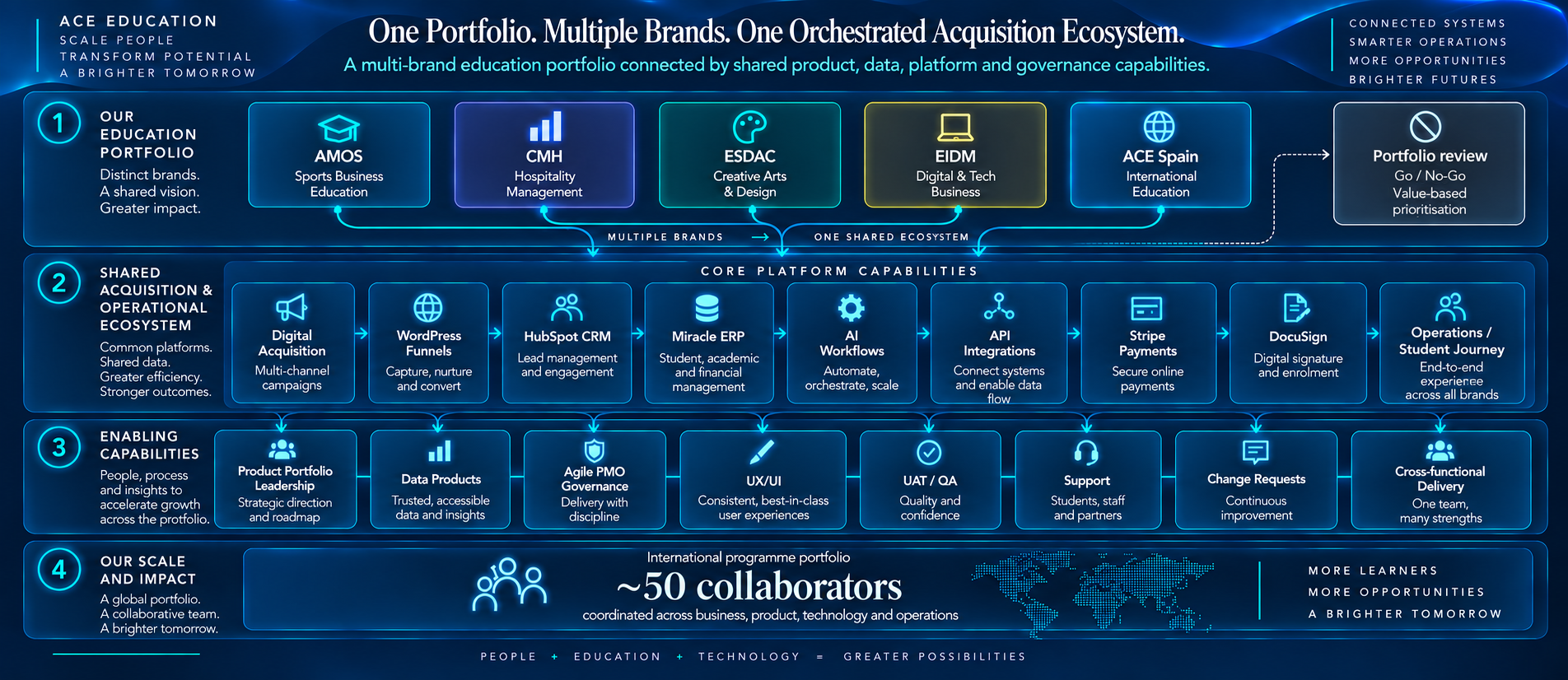
One portfolio. Multiple brands. One orchestrated acquisition ecosystem.

The operating model had to preserve local brand needs while controlling shared product, data, platform and delivery dependencies across France and the international programme.

BRANDS / MARKETS

Demand layer

AMOS · France
CMH · France
ESDAC · France
EIDM · France
ACE Spain · International
SHARED CAPABILITIES

Multi-brand acquisition platform

Digital journeyWordPress sales funnels
CRMHubSpot
EnterpriseMiracle ERP
OrchestrationAI workflows
IntegrationAPI calls · status sync
PaymentsStripe Checkout
E-signatureDocuSign
DeliveryUAT · Support · Production
OPERATING NETWORK

Execution layer

Sales · Marketing
Education · ADV
Finance · Accounting
Product · UX/UI
Engineering · CRM/ERP
Managers · Executives
ACE Education multi-brand acquisition ecosystem diagram
Multi-brand acquisition ecosystemThis visual summarises how active brands, shared platforms and enabling capabilities operated as one programme portfolio.
AMOS · CMH · ESDAC · EIDM · ACE SpainValue-based prioritisationShared capabilities~50 collaborators
03 · MANDATE

Product leadership. Programme-level accountability.

The mandate was to keep the international programme portfolio operational from business demand through technology delivery, PMO governance, LeSS Framework coordination, validation and production.

Product leadership extended across the end-to-end programme portfolio.

I held end-to-end operational delivery responsibility across the active multi-brand portfolio, coordinating approximately 50 contributors across business, product, technology and operations.

The scope included programme and portfolio coordination, data products, AI-enabled workflow automation, enterprise integrations, PMO governance, LeSS Framework, UAT and production readiness, while working directly with managers, stakeholders and executive directors. Over the broader portfolio horizon, 270 features were delivered across 3 years.

PortfolioFrance + Spain

Operational delivery across active brands and international scope.

People~50 collaborators

Cross-functional coordination rather than hierarchical line management.

Data & AIData products · AI workflows

Customer lifecycle data, CRM/ERP synchronization and workflow automation.

Execution frameworkPMO Governance + LeSS Framework

Priorities, dependencies, cadence, risks, status, UAT and Go/No-Go decision support.

04 · OPERATING MODEL

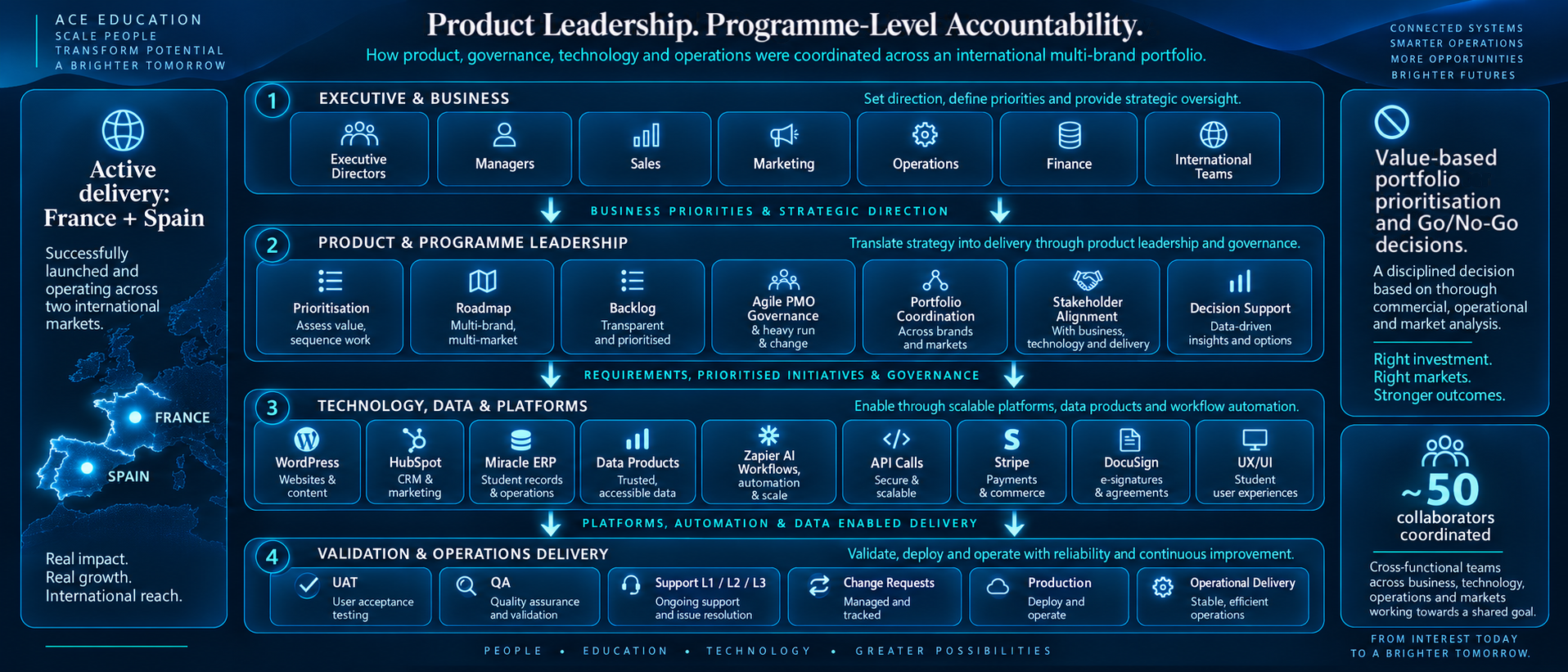
Create the delivery system around the end-to-end journey.

The operating model connected executive priorities, portfolio decisions, product/data ownership, PMO governance, LeSS Framework execution, technology delivery and operational validation into one delivery cadence.

01 · EXECUTIVE & BUSINESS

Value · priorities · arbitration

COMEX, executive directors, Sales, Marketing, Operations, Finance and international stakeholders define priorities, constraints and business outcomes.

02 · PRODUCT / PROGRAMME

Portfolio · roadmap · governance

Prioritisation, PMO governance, LeSS Framework execution, programme backlog, cross-brand dependencies, data products, decision tracking and delivery coordination.

03 · TECHNOLOGY & DATA

Platforms · APIs · IA automation

WordPress, HubSpot, Miracle, Zapier, AI workflows, API integrations, Stripe, DocuSign, UX/UI and engineering implementation.

04 · VALIDATION & OPERATIONS

UAT E2E · Go/No-Go · production

End-to-end validation, business readiness, support, change requests, production progression and operational hand-off.

Operating rule: brand delivery could not be managed locally in isolation — shared data, systems and dependencies had to be governed at programme-portfolio level.
Programme-level accountability operating model diagram
Product leadership. Programme-level accountability.The operating model visual highlights how executive direction, portfolio governance, platforms and operations were coordinated across France, Spain and the wider international programme.
Executive DirectorsPMO GovernanceLeSS Framework~50 collaborators coordinated
05 · TECHNICAL STORY

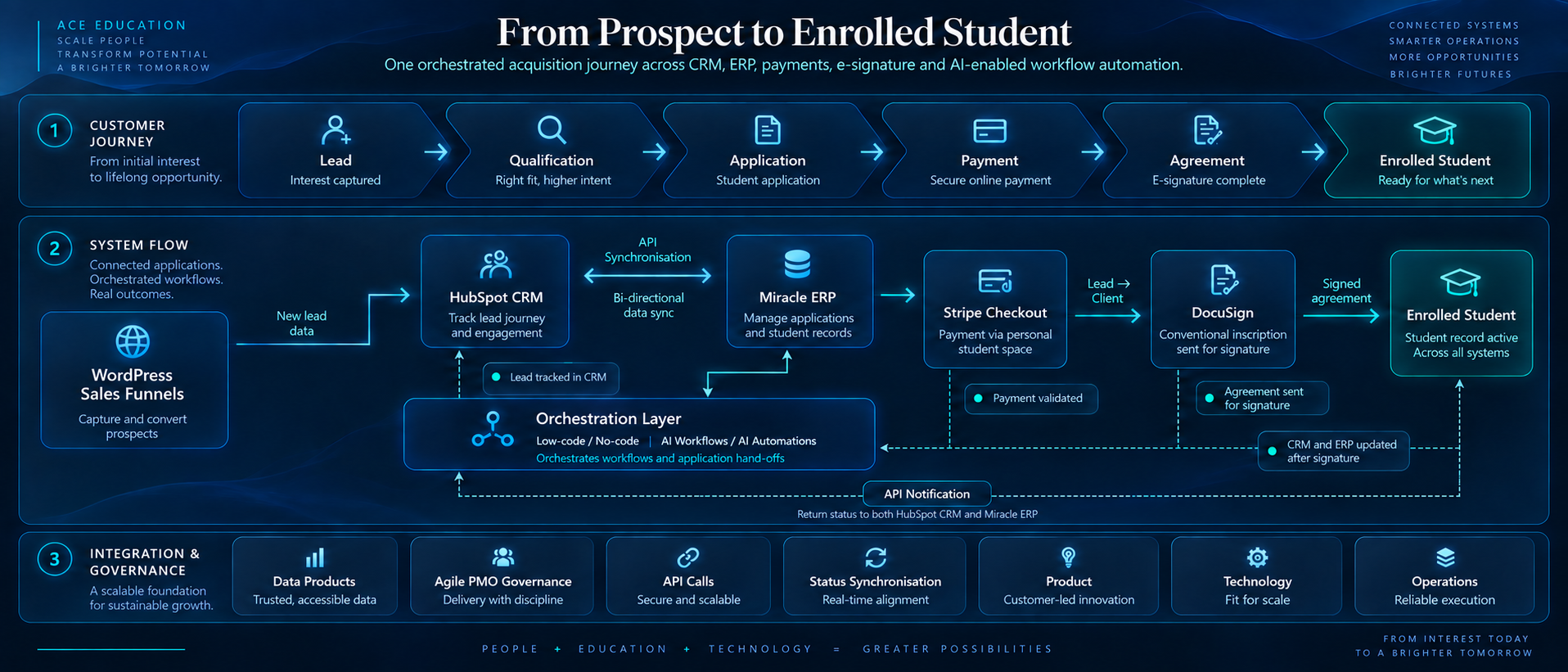
From prospect to enrolled student, one orchestrated digital journey.

The acquisition architecture connected customer-facing funnels with CRM, ERP, workflow automation, payment and e-signature, using APIs and synchronized status changes to complete the student journey.

Customer lifecycle

01Lead captured
02Lead qualified & tracked
03Application / customer record synchronized
04Stripe payment completed
05Lead → Client
06DocuSign agreement issued
07Signed status synchronized
08Enrolled student

Application & integration architecture

Reconstructed portfolio architecture showing how customer-facing applications, enterprise systems, workflow automation, APIs and synchronized state transitions supported the end-to-end acquisition journey.

AcquisitionWordPress

Sales funnels capture prospect and application data.

CRMHubSpot

Lead lifecycle, qualification and commercial follow-up.

ERPMiracle

Customer / enrolment record and operational processing.

PaymentStripe

Checkout from the applicant's personal space validates payment.

E-signatureDocuSign

ERP-triggered enrolment agreement and signed-status callback.

Orchestration layerLow-code / No-code · AI workflows

Automates selected lead and process interactions across the acquisition journey.

Integration layerAPI calls · bi-directional status synchronization

CRM and ERP records remain aligned as payment and signature states progress.

State progressionLead → Client → Enrolled Student

Commercial, payment and enrolment states advance through controlled hand-offs.

Data synchronizationCRM ↔ ERP customer and enrolment records

Core customer and application data remains synchronized across operational systems.

Operational controlsPayment validation · signed-status callback · workflow hand-offs

Key completion events trigger the next controlled step in the student journey.

Prospect to enrolled student journey architecture diagram
Prospect-to-student orchestration.The end-to-end acquisition journey connected WordPress sales funnels, HubSpot CRM, AI workflows, Miracle ERP, Stripe Checkout and DocuSign through API-driven status progression.
Lead → Client → Enrolled StudentAI workflowsStripe CheckoutDocuSign
06 · DATA PRODUCTS

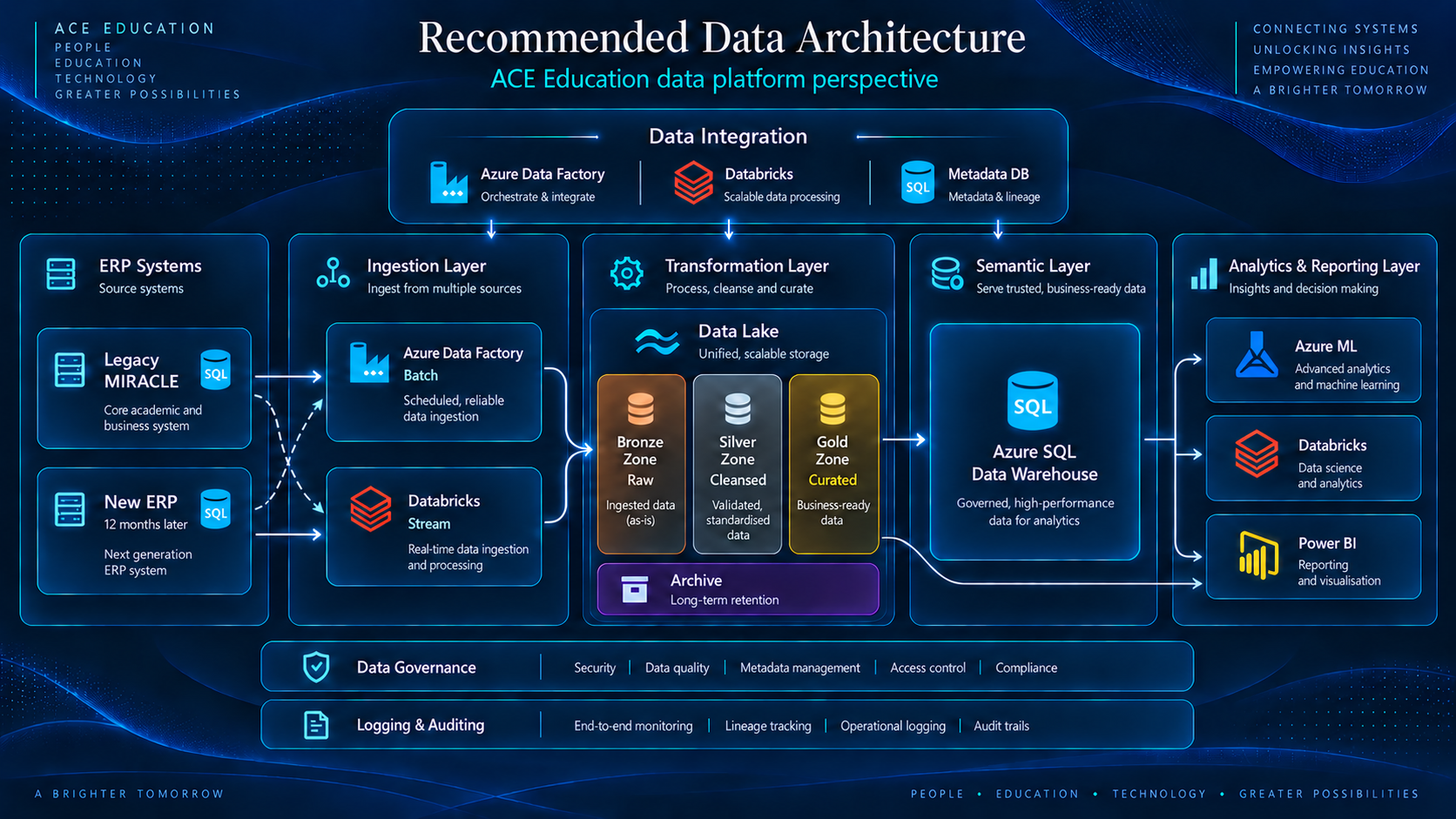
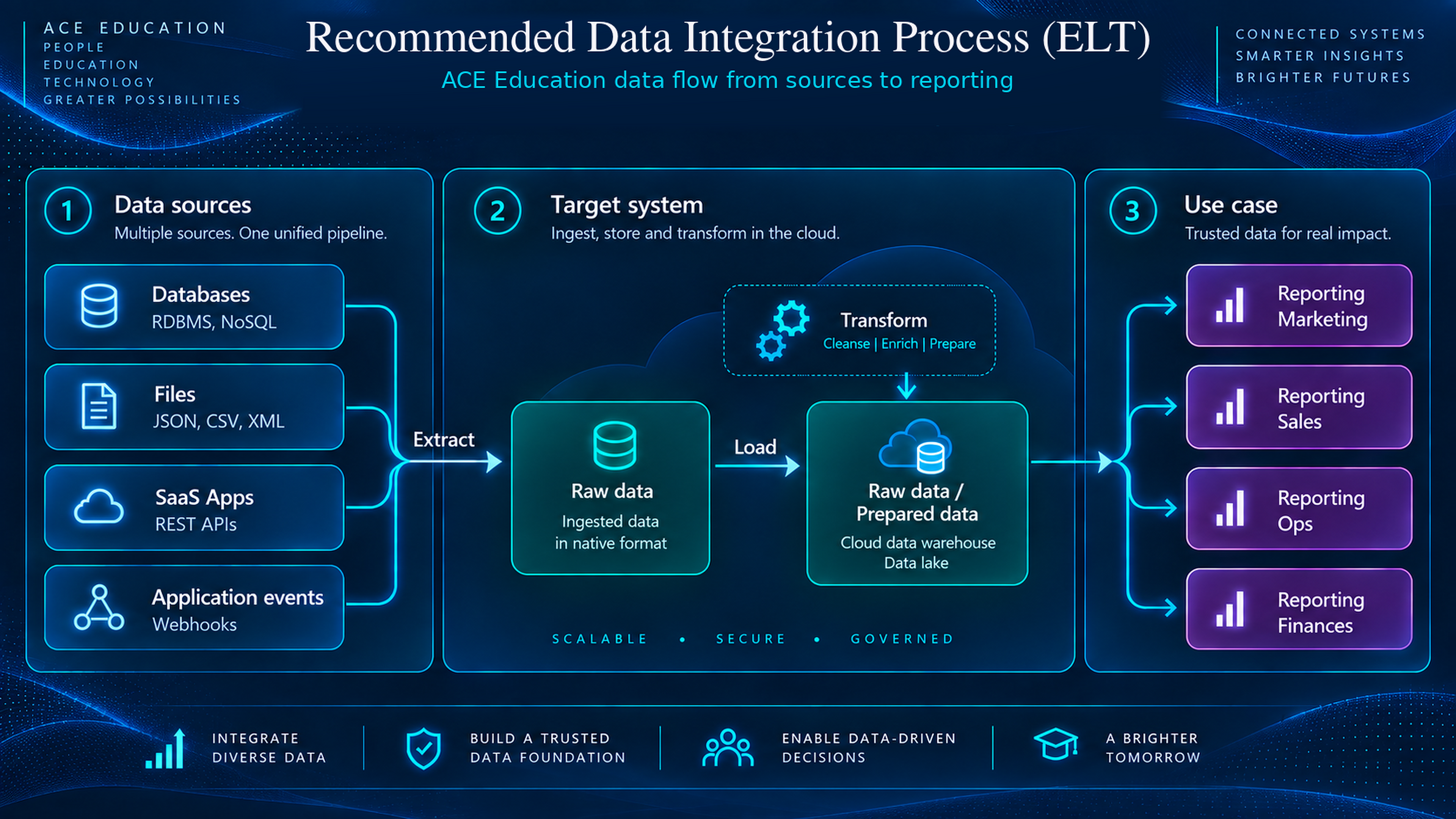
Data architecture and ELT integration were part of the portfolio scope.

The programme also covered data products and reporting enablement, with a recommended architecture built around Azure data services, Databricks, a governed data lake, semantic consumption and reporting-ready ELT flows.

ACE Education recommended data architecture
Recommended data architectureA perspective view of ERP source systems, ingestion, transformation, semantic and analytics layers, supported by governance and auditing controls.
Azure Data FactoryDatabricksAzure SQL Data WarehousePower BI
ACE Education recommended data integration process
Recommended ELT integration processA cloud-oriented data integration flow from multiple source types into raw and prepared data, designed to support trusted reporting use cases.
Databases · Files · SaaS Apps · WebhooksELTReporting
07 · LEADERSHIP INTERVENTIONS

Structure. Orchestrate.Scale & govern.

The contribution was not more administration. It was building the operating mechanisms required to make a complex multi-brand portfolio executable.

01 · STRUCTURE

Build the Agile PMO.

Create visibility across priorities, roadmaps, risks, dependencies, UAT and decisions through a PMO Governance + LeSS Framework so business and technology teams could work from one programme view.

PMO Governance · LeSS Framework · Delivery cadence
02 · ORCHESTRATE

Connect product, data & systems.

Coordinate CRM/ERP data, APIs, AI-enabled workflows, payments, e-signature and operational status progression around one end-to-end acquisition journey.

Data products · APIs · Automation
03 · SCALE & GOVERN

Run the portfolio against value.

Coordinate ~50 collaborators across France and Spain, scale active brands, and challenge continuation where the business case did not justify forecast benefits.

International portfolio · Value discipline
08 · PORTFOLIO GOVERNANCE

Delivery also means knowing when not to proceed.

A programme portfolio is governed by value, not by activity. Active delivery and investment discipline were therefore part of the same accountability.

Deliver

France & Spain

Multi-brand acquisition initiatives moved through product delivery, integration, UAT, business readiness and operational execution under the common programme model.

No-Go / stop

Investment discipline

Continuation decisions were guided by business justification, forecast benefits and delivery readiness.

09 · EXECUTION EVIDENCE

Governance translated into visible delivery evidence.

The case is supported by an extensive programme corpus rather than retrospective narrative alone. Public presentation remains abstracted to protect commercially sensitive information.

Governance

Weekly · Monthly · Quarterly programme reporting

Status, risks, milestones, dependencies, team availability and next-step tracking across active brands and the wider international programme.

Portfolio

PPM & CODIR arbitration

Portfolio views and executive arbitration material connecting programme priorities, resource constraints and delivery decisions.

Quality

UAT & Go / No-Go

End-to-end validation and production-readiness decision points across multiple sales-funnel initiatives.

Platforms

CRM, data, AI & platform artefacts

HubSpot programme material, portfolio backlogs, data architecture, data integration design and shared-system dependencies across the operating ecosystem.

Evidence rule: programme/team metrics are treated as programme evidence. They are not presented as individual performance claims, and commercial student-volume metrics remain excluded until documentary reconciliation is complete.
10 · IMPACT

From fragmented delivery to an orchestrated acquisition ecosystem.

The programme combined acquisition delivery, AI-enabled CRM automation and clarified IT/Data governance. The engagement contributed to collective business performance, alongside stronger delivery capabilities and decision support.

Revenue growth+32%

Revenue growth to which the programme contributed as part of collective business performance.

CI/CD & project delivery80%

Improvement in CI/CD and project delivery performance.

AI-enabled CRM automation70%

Share of CRM tasks automated through AI-enabled workflows.

Service performance>97%

Reported SLA level.

Reported programme results. These indicators describe business and operational performance; they do not constitute a calculated financial return on investment.

Delivery evidence270 features

Delivered over 3 years across the international multi-brand programme portfolio.

Coordination scale~50 collaborators

Coordinated across business, product, technology and operations.

Execution frameworkPMO Governance + LeSS Framework

Structured portfolio cadence, cross-team dependency management and delivery governance.

Active deliveryFrance + Spain

Operational delivery across active markets, with UK assessed separately under portfolio discipline.

Commercial growth

Multi-brand acquisition

A common acquisition model supporting active brands and contributing to collective revenue growth.

Customer value

Integrated lifecycle

A connected prospect-to-enrolment journey, supported by a reported SLA level above 97%.

Operational efficiency

CRM task automation

AI-enabled workflows automated 70% of CRM tasks across connected applications.

Data / AI

Stronger decision support

Aligned lifecycle data and clarified IT/Data governance strengthened decision support.

Governance

Delivery discipline

Shared priorities, ownership and portfolio cadence supported an 80% improvement in CI/CD and project delivery performance. Clarified IT/Data governance and met GDPR and ISO/IEC 27001 requirements within the project scope.

Product Portfolio LeadershipDigital & Commercial TransformationOperating Model DesignCRM / ERP & API IntegrationData Products & Workflow AutomationPMO Governance + LeSS Framework
11 · OUTCOME & LEADERSHIP VALUE

The business value of end-to-end portfolio delivery.

The programme connected acquisition journeys, enterprise systems, AI-enabled automation and IT/Data governance. Its value spans commercial growth, operational efficiency, customer service and disciplined portfolio decisions.

Four business focus areas, with business, technology and behavioural outcomes from the ACE Education programme portfolio.
Business focusThe strategic objectiveBusiness outcomesValue delivered or enabledTechnology outcomesCapabilities deliveredBehavioural outcomesWorking practices established
Commercial Growth

Contributed to 32% revenue growth through coordinated multi-brand acquisition delivery across France and Spain, as part of collective business performance.

Connected WordPress funnels, HubSpot, Miracle, Stripe and DocuSign through APIs and synchronised lifecycle states.

Aligned sales, marketing, operations and technology around shared acquisition priorities and cross-brand dependencies.

Operational Efficiency

Achieved an 80% improvement in CI/CD and project delivery performance. AI-enabled workflows automated 70% of CRM tasks.

Combined AI-enabled CRM task automation, workflow orchestration and CRM/ERP status synchronisation across payment, agreement and enrolment stages.

Established shared priorities, delivery cadence, UAT and operational hand-offs through PMO governance and the LeSS Framework.

Customer Value

Supported a coherent applicant journey from lead capture to enrolment, with a reported SLA level above 97%.

Linked personal-space checkout, electronic signature and application records through controlled status progression.

Connected commercial follow-up, administration and support around shared lifecycle milestones.

Risk Management

Met GDPR and ISO/IEC 27001 compliance requirements within the project scope, with clarified IT/Data responsibilities and strengthened governance and decision support. Applied value-based continuation decisions, including Go/No-Go reviews grounded in business justification and forecast benefits.

Used payment validation, signed-status callbacks and CRM/ERP synchronisation as control points in the acquisition journey.

Clarified responsibilities and escalation paths. Made risks, dependencies, UAT evidence and executive arbitration part of Go/No-Go and production-readiness decisions.

Value framing: the figures in Impact are reported programme outcomes. Revenue growth reflects collective business performance to which the engagement contributed. ROI — Return on Investment requires an assessment of attributable benefits against investment and operating costs; these performance indicators alone do not establish a financial ROI.

Employee value and future potential

Complementary perspectives on the programme: employee benefits to document and strategic options to validate.

Employee benefits to document

ROE — Return on Employee

CRM automation, clearer governance and shared delivery practices created conditions for more focused work and better coordination.

  • Less repetitive CRM handlingAutomating 70% of CRM tasks creates capacity for qualification, support and exception handling. Time saved and employee experience remain to be assessed.
  • Clearer IT/Data responsibilitiesDefined ownership, priorities and escalation paths help teams understand their responsibilities. Effects on autonomy and decision quality remain to be documented.
  • Shared decisions and delivery practicesStronger decision support and a common delivery cadence support consistent prioritisation and coordination across business, Product, IT and Data.

Automation and governance are established programme outcomes. Their effects on employee capacity, collaboration and experience require further evidence.

Future options to validate

ROF — Return on the Future

Shared acquisition and data/AI capabilities create options for future development beyond the existing programme.

  • Extension of shared acquisition capabilitiesThe multi-brand operating model provides a foundation for additional brands, markets or services. Future expansion and economic value require validation.
  • Reusable data and AI capabilitiesThese capabilities qualify as ROF where they enable genuinely new services or business models beyond existing acquisition workflows.

ROF describes strategic potential. New offerings, adoption and economic value remain to be validated; the reported operational gains are achieved performance outcomes.

CASE TAKEAWAY

Product was the entry point. End-to-end execution was the mandate.

ACE Education demonstrates the ability to coordinate a complex international programme portfolio where commercial journeys, enterprise systems, data flows, automation and executive governance must work as one operating system.

Leadership mandateProgramme leadership
Effective accountabilityInternational programme portfolio · E2E operations delivery
Delivery execution frameworkPMO Governance + LeSS Framework
Leadership scale~50 collaborators coordinated
Delivery evidence270 features
Core domainsProduct · Data · AI · Governance
Next case study · 05

DOCAPOSTE — Data Hub & AI Services Industrialisation

Return to the validated Case Studies Hub to continue through the portfolio.

→