ABOUT EXPERIENCE CASE STUDIES INSIGHTS CONTACT
03 · Case Study · NEXWAY / KASPERSKY

Making a legacySubscription domainexecution-ready.

NEXWAY / KASPERSKY operated a complex global subscription domain with fragmented product definition, rigid lifecycle management, incomplete data visibility, payment friction and legacy platform constraints. Mandated to structure the product strategy and redesign, I connected multi-persona discovery, customer journeys, value propositions, portfolio prioritisation, data, payments, APIs and platform requirements into one coherent, execution-ready product package.

Make the domain explicit · connect evidence to value · prioritise the portfolio · prepare execution.
Product StrategySubscriptionProduct DiscoveryPortfolio PrioritisationPayments & APIsPCI DSSISO/IEC 27001
NEXWAY Kaspersky global subscription product lifecycle visual
01 · DISCOVERY MANDATE

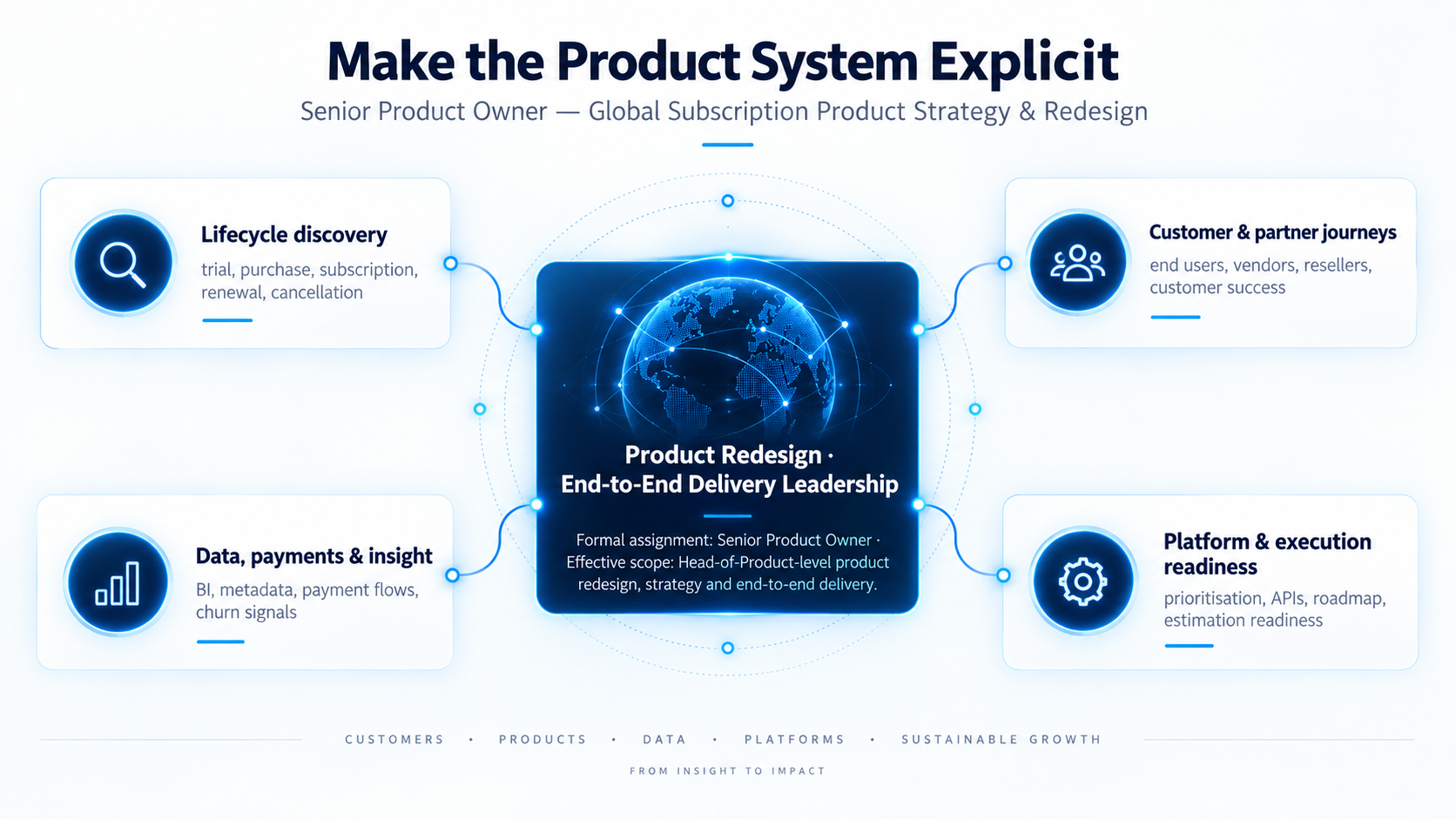
Make the product system explicit.

The effective scope extended from current-state analysis and
multi-persona discovery through product vision, portfolio design,
prioritisation, data requirements, payments and platform direction,
with the objective of preparing a coherent product package for execution.

Make the Product System Explicit infographic
Formal assignment

Senior Product Owner — Global Subscription Product Strategy & Redesign

The portfolio should demonstrate the level of work through the breadth and quality of the product system rather than convert that scope into a historical Head of Product title.

Effective scope

Head-of-Product-level product delivery discovery, strategy, portfolio design and execution readiness across subscription, customer experience, payments, data and platform redesign.

01 · Lifecycle

Map the end-to-end system

Understand trial, purchase, subscription, change, renewal, cancellation and customer relationships as one connected value stream.

02 · Customer value

Design across personas

Connect end users, vendors, resellers, customer success, payments, data, marketing and engineering.

03 · Data

Make insight usable

Define the data, metadata, events and KPI foundations required for lifecycle visibility, retention and forecasting.

04 · Platform

Prepare reusable capabilities

Translate product needs into API, payment, migration and platform requirements suitable for target engineering.

01Evidence before assumption
02Multi-persona discovery
03Value before feature volume
04Prioritise explicitly
05Expose dependencies
06Connect product to data
07Design for execution
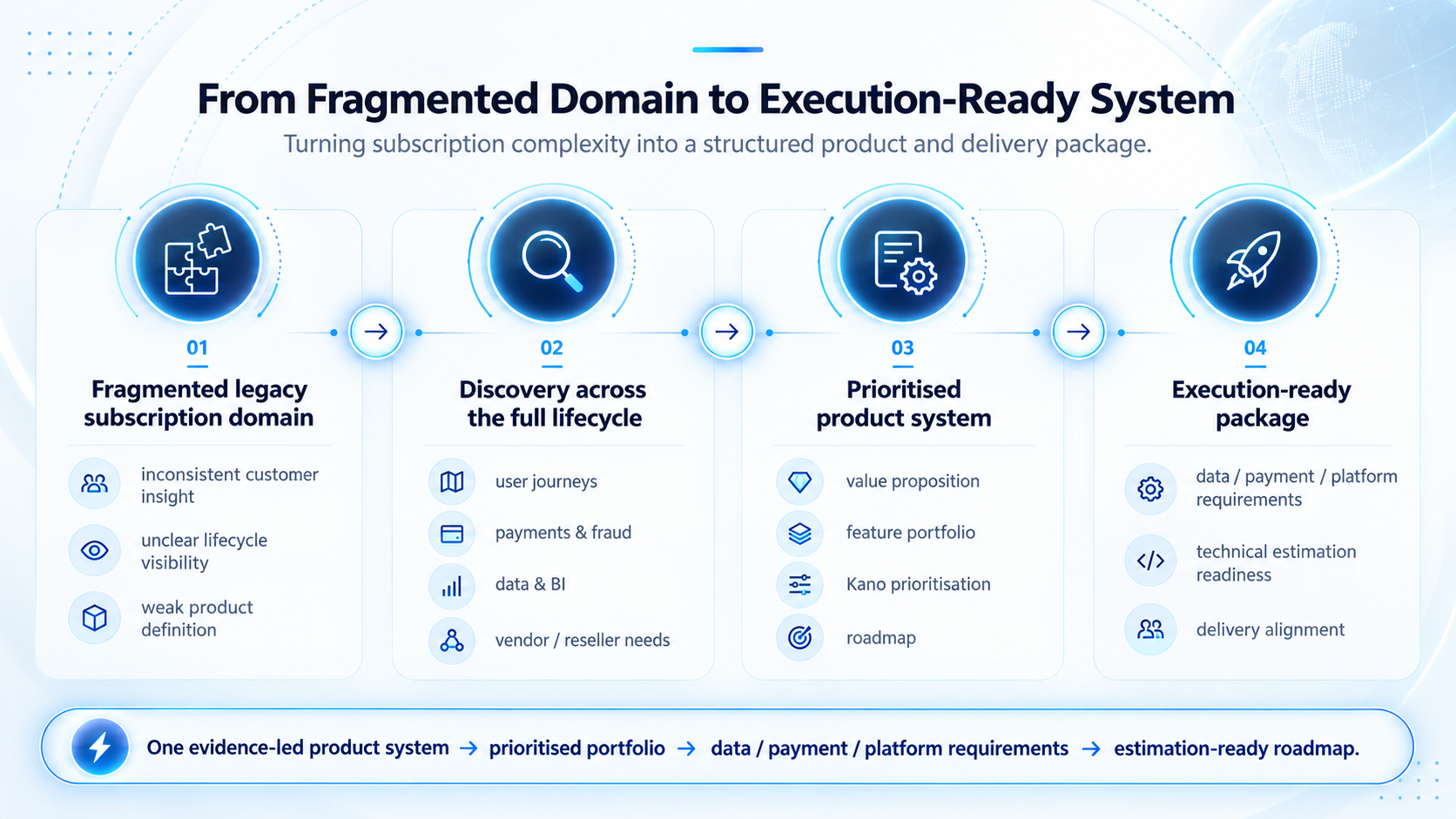
02 · DISCOVERY-TO-EXECUTION TRANSFORMATION

From fragmented domain to execution-ready system.

The work moved through a deliberate sequence: understand the current state, make customer and operating needs visible, create the product strategy, prioritise the portfolio, connect product decisions to data and platform capabilities, then prepare the roadmap for technical estimation.

01 · Diagnose

Map current state

Reconstruct subscription journeys, pain points and operational constraints.

02 · Discover

Map ecosystem

Capture needs across customers, partners and enabling functions.

03 · Define

Shape value

Establish product vision, value propositions and business-model logic.

04 · Prioritise

Design portfolio

Structure features, hypotheses, KPIs, priorities and dependencies.

05 · Connect

Shape platform

Link product choices to data, payments, APIs and migration requirements.

06 · Prepare

Ready execution

Translate the strategy into roadmap, backlog and estimation-ready material.

From Fragmented Domain to Execution-Ready System infographic
03 · PRODUCT DISCOVERY & STRATEGY ENGINE

How evidence became decisions.

The discovery package was not a collection of isolated workshops. It formed a connected decision system from customer journeys and value propositions through feature hypotheses, prioritisation, data requirements, payments, APIs and roadmap readiness.

01 · CURRENT STATE

Reconstruct the lifecycle

Map subscription fulfilment, operational value stream and major friction points.

02 · PERSONAS

Discover across the ecosystem

End users, vendors, resellers, CSM, payments, data, marketing and engineering.

03 · VALUE

Define propositions

Translate needs into customer, partner and operating value propositions.

04 · VISION

Shape the target product

Connect flexibility, self-management, retention, billing and customer insight.

05 · PORTFOLIO

Structure features

Build a portfolio of feature hypotheses with objectives, KPIs and dependencies.

06 · PRIORITY

Sequence investment

Use explicit priority tiers, Kano thinking, risk/opportunity and Cost of Delay fields.

07 · PLATFORM

Connect enabling capabilities

Define data, payment, API, migration and platform needs that support the product.

08 · EXECUTION

Prepare the roadmap

Move the prioritised product package toward technical estimation and scheduling.

Output: one coherent product-strategy package.Customer evidence → value proposition → prioritised portfolio → data / payments / platform requirements → roadmap and execution preparation.
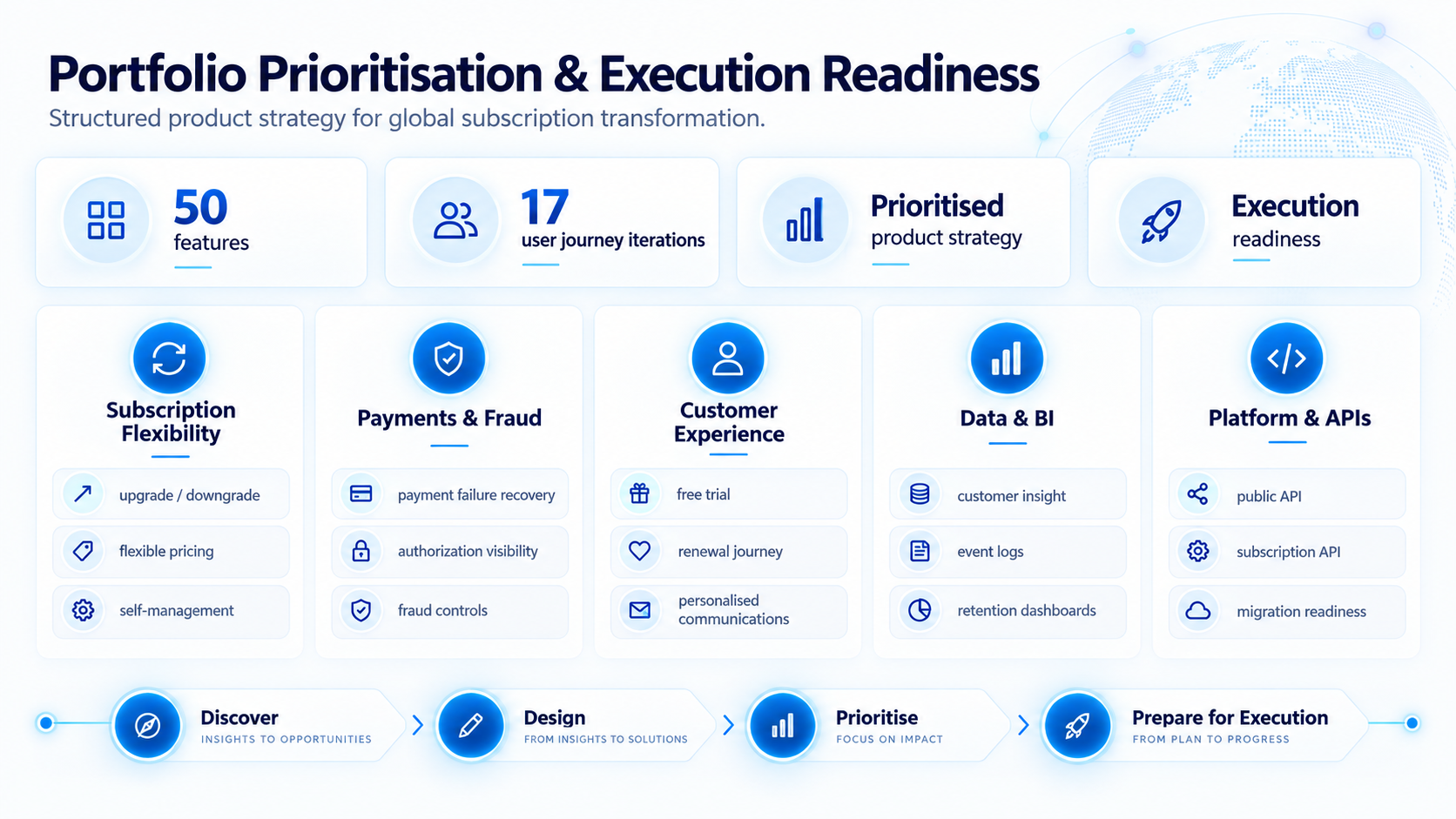
04 · PRODUCT PORTFOLIO & PRIORITISATION

Translate discovery into an investable portfolio.

The feature portfolio connected customer problems to explicit value hypotheses, KPIs, time criticality, dependencies, risk reduction / opportunity enablement, non-functional requirements and Cost of Delay fields.

01

Flexible subscription models

Design flexibility across plans, pricing, billing intervals, upgrade / downgrade, trials, migration and bundles.

DirectionReduce rigidity across the lifecycle.
EvidenceLargest feature family in the structured portfolio.
02

Self-management

Give customers and partners clearer control over subscription configuration and lifecycle changes.

DirectionShift routine actions toward self-service.
EvidenceJourney and feature artefacts.
03

Retention & churn intelligence

Connect customer behaviour, cancellation signals, dashboards, forecasting and experimentation to retention decisions.

DirectionMake churn observable and actionable.
EvidenceChurn detection / prevention feature groups.
04

Payments & fraud resilience

Address payment failure, method updates, chargebacks, prebilling, retries and authorisation visibility.

DirectionTreat payment friction as product friction.
EvidencePayment value proposition and discovery material.
05

API & platform reusability

Connect subscription capabilities to public / stand-alone APIs, external commerce, gateways and migration requirements.

DirectionDesign reusable platform capabilities.
BoundaryImplementation-specific details are intentionally omitted from this public overview.
06

Data & KPI foundations

Improve event logging, metadata, lifecycle status, customer insight and KPI referentials required for decision-making.

DirectionProduct strategy requires governed data.
BoundaryNo unsupported data-improvement KPI is claimed.
Portfolio Prioritisation and Execution Readiness dashboard
05 · CUSTOMER & OPERATING ECOSYSTEM

One subscription product.Multiple actors and dependencies.

The discovery deliberately extended beyond a single end-user journey. Product decisions had to work across customers, commercial partners, operating teams and the enabling data / payment / engineering system.

01 · Customer

End User — B2B / B2C

Subscription flexibility, trials, upgrade / downgrade, pause / resume, cancellation, renewal, billing flexibility, notifications and self-management.

ValueSimple, flexible lifecycle control
SignalsCustomer behaviour · churn · loyalty
ExperiencePortal · communication · billing
02 · Commercial ecosystem

Vendors · Resellers · CSM · Growth

Plan configuration, pricing, customer insight, retention, onboarding, support and subscription-performance visibility.

ValueConfigurable offers and partner autonomy
SignalsMRR · AOV · CLV · retention thinking
GrowthTrials · pricing · A/B testing · churn prevention
03 · Enabling platform

Payments · Fraud · Data · Engineering

Payment recovery, authorisation visibility, event logging, metadata, migration, APIs and reusable platform capabilities.

DataLifecycle visibility · KPI referential
PlatformPublic / stand-alone APIs · migration
PaymentsFailure journeys · retries · method updates
Trial
Purchase
Subscribe
Change
Renew
Cancel / Retain
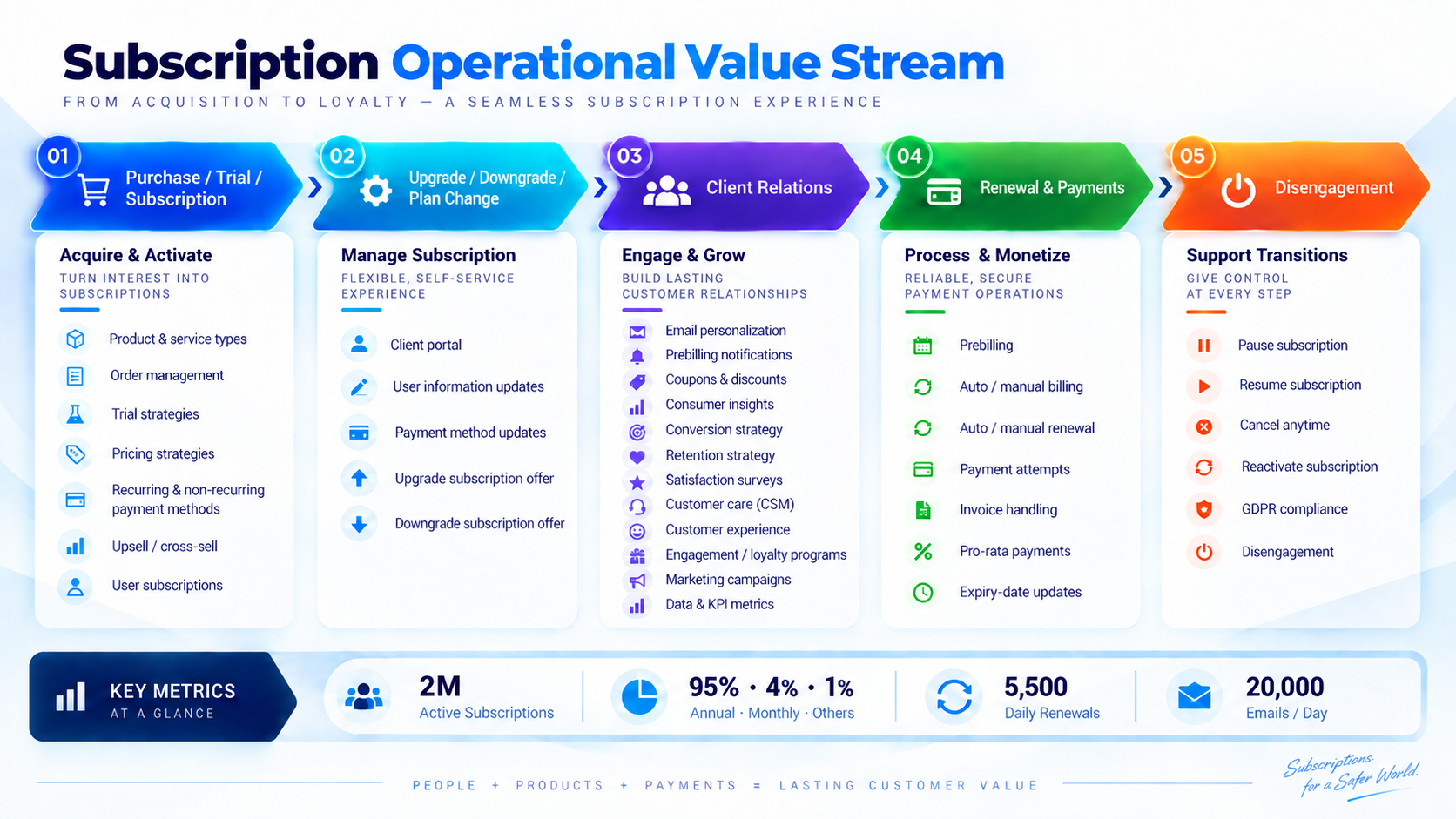
Product rule: a subscription capability is not a local UI feature. Its customer value, data signals, payment behaviour, partner implications and platform dependencies must be considered together. Scale context: the volumes shown in the visuals describe subscription operating scale; they are not presented as increases generated by this engagement.
Subscription Operational Value Stream infographic
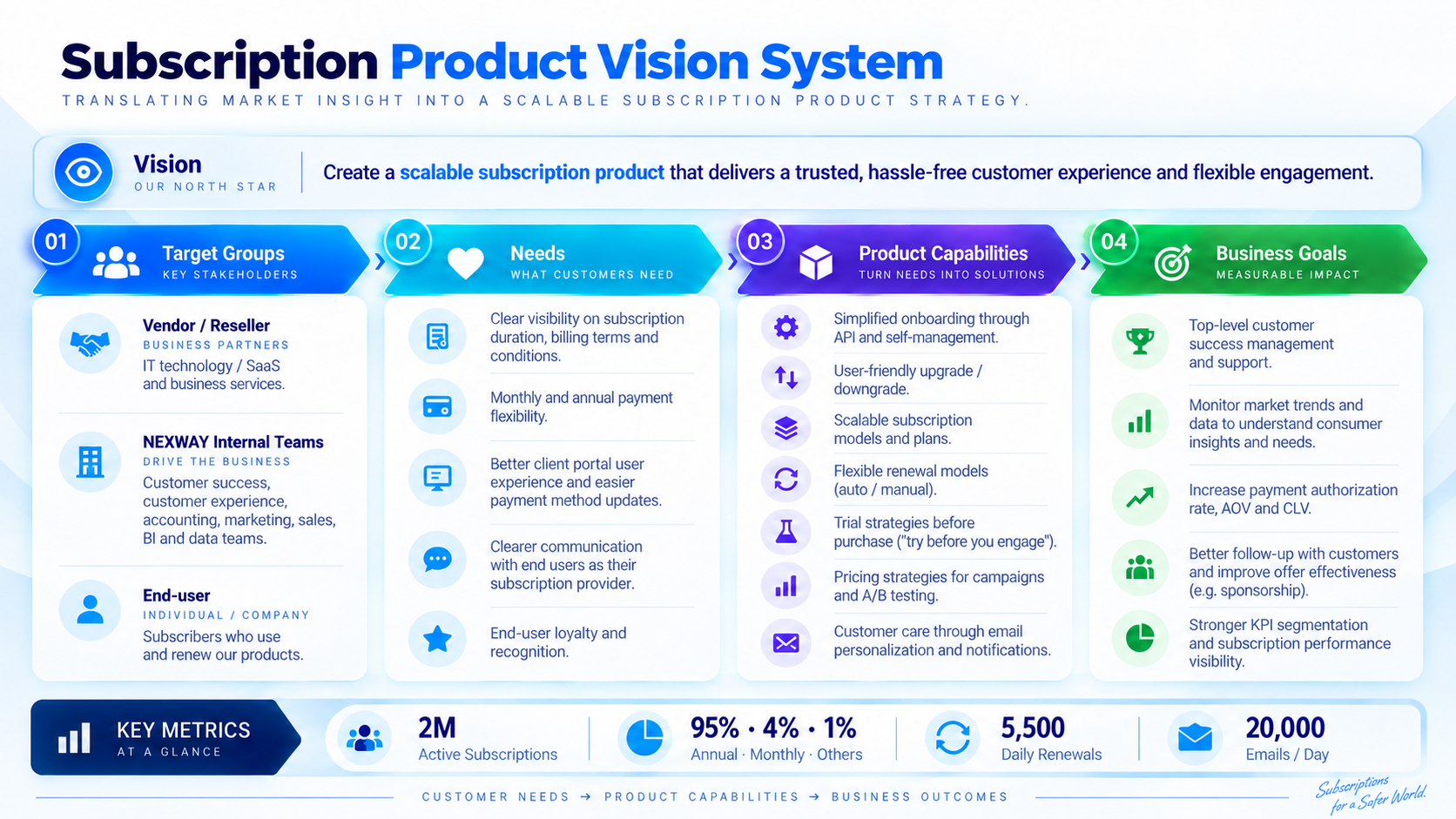
Subscription Product Vision System infographic
06 · EVIDENCE & CONFIDENTIALITY

Proof of discovery depth
without overstating impact.

The evidence base is unusually strong for product discovery and portfolio design, but commercially sensitive product, payment, fraud, architecture and customer details must remain controlled.

50

Structured feature rows

The main feature workbook contains 50 populated feature rows across flexible subscription, churn, payments, reporting, self-management and revenue.

17

Journey iterations

Customer Journey Map run through supporting an iterative discovery process rather than one static deliverable.

32

Final discovery

The final Customer Journey package contains personas, value propositions, vision, roadmap and prioritisation.

✓

Provenance evidence

Office metadata across central artefacts supports my direct involvement while preserving attribution for third-party templates and starting material.

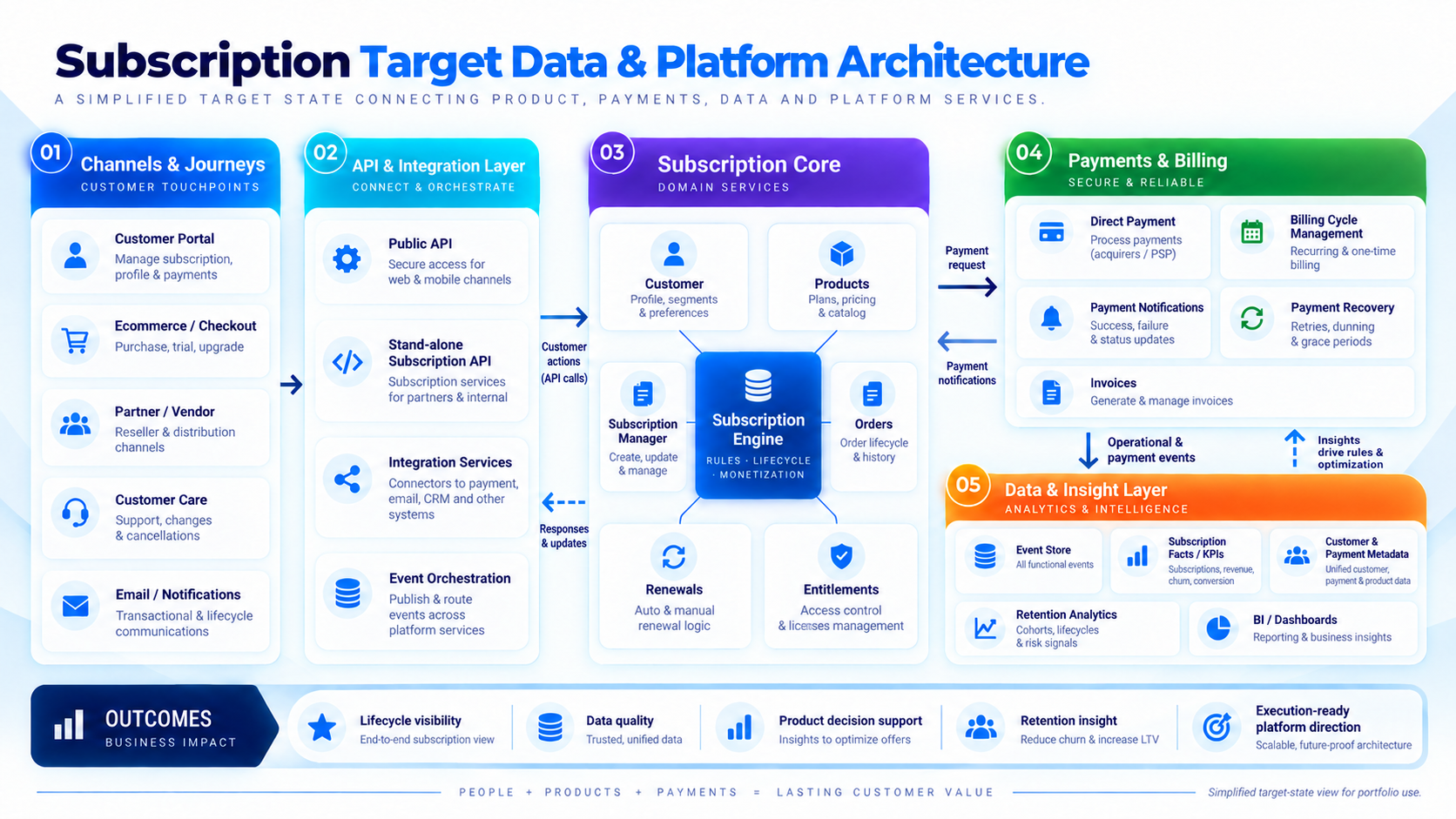
Subscription Target Data and Platform Architecture infographic
Confidentiality rule: Selected product, data, payment and architecture details are withheld due to commercial and operational sensitivity. Raw internal backlogs, credentials, internal URLs, fraud controls and customer information are not intended for public portfolio publication.
07 · ROADMAP & EXECUTION READINESS

Legacy vs designed vs execution-ready.

The strongest defensible transformation is the movement from fragmented product understanding to a structured package capable of supporting technical estimation, scheduling and the intended next development phase.

Inherited

Fragmented product definition

The subscription domain had limited strategic definition and uneven product / data visibility.

  • Rigid subscription lifecycle
  • Incomplete product artefacts
  • Fragmented data and limited lifecycle visibility
  • Payment friction
  • Legacy platform constraints
Designed

Integrated product strategy

Discovery created a connected system of customer, portfolio and platform decisions.

  • Multi-persona journey maps
  • Value propositions & product vision
  • 50-row structured feature portfolio
  • Priority / Kano / dependency logic
  • Data, payment & API requirements
Execution ready

Roadmap prepared for estimation

The prioritised product package provided the basis for technical estimation and execution planning.

  • Product roadmap
  • User-story mapping
  • Feature canvases
  • Backlog / weekly execution material
  • Handoff toward estimation & scheduling
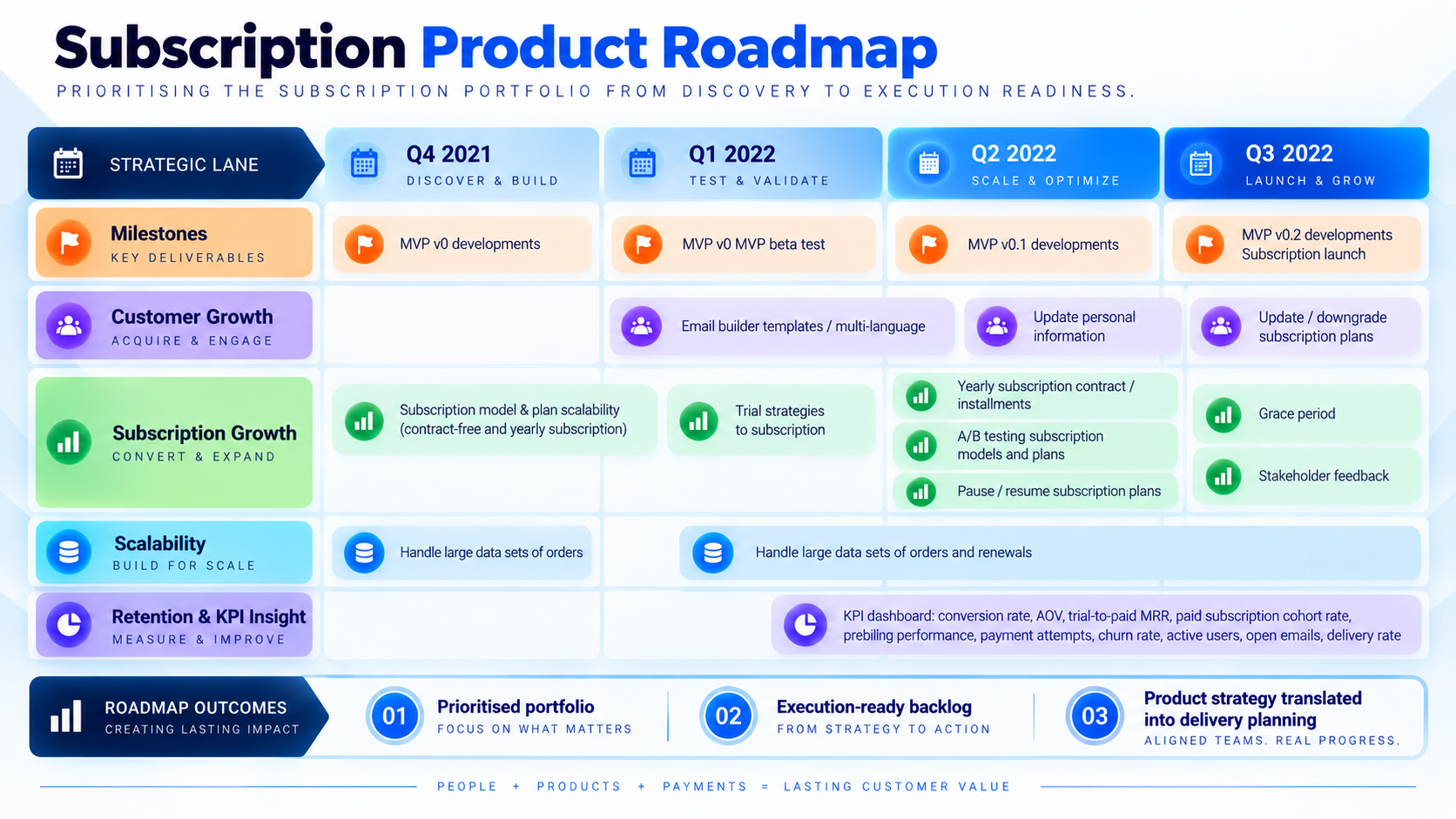
Subscription Product Roadmap infographic
Proposed roadmap: the dated milestones show the intended delivery sequence, not confirmed production releases. The engagement established product strategy, design and execution readiness; post-launch commercial and operational results remain outside the documented outcome scope.
08 · OUTCOME & LEADERSHIP VALUE

Strategic value and execution readiness.

The engagement structured the subscription product strategy, redesigned operating requirements and prepared a prioritised package for technical estimation. PCI DSS, GDPR and ISO/IEC 27001 compliance objectives were achieved for the subscription, payment, data and platform requirements covered by the engagement. The tables below distinguish these results from the benefits expected after implementation.

Defensible outcome

From fragmented understanding to an execution-ready redesign.

The subscription domain gained a structured product vision, a prioritised portfolio and defined customer, payment, data and platform requirements. The package was prepared for technical estimation and scheduling, with compliance objectives achieved for the requirements within the engagement scope.

Product strategy, execution readiness and compliance objectives achieved; commercial and operational returns remain to be evaluated after implementation.
Leadership takeaway

Product strategy is the orchestration of evidence, value and constraints.

The work required more than backlog ownership: it connected multiple personas, lifecycle economics, product vision, data governance, payment behaviour, feature prioritisation and target platform capabilities into one coherent transformation path.

Discovery → Value → Portfolio → Data & Platform → Execution Readiness.
Business value · Achieved & expected outcomes

The business value of subscription transformation.

Discovery connected customer needs, subscription economics, operating processes and platform requirements. The first table presents outcomes achieved during the engagement; the second presents benefits to realise and measure after implementation.

During the engagement

Outcomes achieved during the engagement

Strategy, design, compliance and execution readiness.

Four primary business objectives with business, technology and behavioural outcomes.
Primary business objectiveBusiness outcomesValue achievedTechnology outcomesCapabilities structuredBehavioural outcomesPractices demonstrated
Commercial Growth

Defined the product vision, value propositions and logic of the new subscription business model.

Specified subscription engine, billing and API requirements to support the proposed offers.

Incorporated vendor, reseller, Growth and Customer Success perspectives into product decisions.

Operational Efficiency

Redesigned the operational value stream and payment/fraud processes; prioritised the product portfolio and prepared it for technical estimation.

Defined lifecycle, data, integration and target architecture requirements.

Made priorities, dependencies and trade-offs explicit across Product, Engineering, Data and Payments.

Customer Value

Translated customer and partner needs into clear value propositions and coherent subscription journeys.

Designed journeys and requirements for plan changes, renewal, cancellation, billing and self-management.

Used iterative discovery across multiple personas to connect user needs with product choices.

Risk Management

Achieved PCI DSS, GDPR and ISO/IEC 27001 compliance objectives for the requirements within the engagement scope.

Incorporated compliance requirements into payment, data and platform design requirements.

Embedded risks, compliance constraints and non-functional requirements in prioritisation and execution preparation.

After implementation

Expected outcomes after implementation

Value to realise and measure after implementation.

Four primary business objectives with business, technology and behavioural outcomes.
Primary business objectiveBusiness outcomesBenefits soughtTechnology outcomesCapabilities to demonstrateBehavioural outcomesChanges to observe
Commercial Growth

Enable new monetisation opportunities and more flexible offers; assess their contribution to revenue and retention. ROF orientation, with ROI to be evaluated.

A subscription engine supporting new plans, pricing, trials, bundles and billing arrangements.

Commercial teams and partners able to configure, explain and sell the new offers.

Operational Efficiency

Reduce manual interventions, payment friction and processing times. Operational ROI to be evaluated.

Integrated workflows, APIs and lifecycle data that are reliable and usable in production.

Adoption of the redesigned processes, effective coordination and use of data in operational decisions.

Customer Value

Increase customer and partner autonomy; improve journey simplicity and issue resolution.

Working self-management, subscription changes, renewal, cancellation and notification capabilities.

Users adopting the new services; support teams able to guide journeys and handle exceptions.

Risk Management

Maintain compliance as the platform evolves and strengthen control of fraud, billing and data-quality risks.

Controls, traceability and exception-handling mechanisms that can be verified in operation.

Active oversight, incident reporting and changes subject to appropriate validation.

Return perspectives: ROF means Return on the Future; ROI means Return on Investment. Commercial and operational returns remain to be evaluated after implementation.

ROE — Return on Employee: expected improvements in employees’ understanding of the domain, autonomy, coordination and decision quality complement this assessment. These benefits remain to be observed and documented.

Make the domain visible → turn evidence into product choices → make priorities explicit → prepare execution.
Source rule: The formal historical title remains Senior Product Owner. “Head-of-Product-level” describes the demonstrated scope of work, not a contractual title. Compliance statements concern the requirements covered by this engagement; they do not assert organisation-wide certification. Post-launch commercial impact remains outside the public claim set until additional evidence is verified.